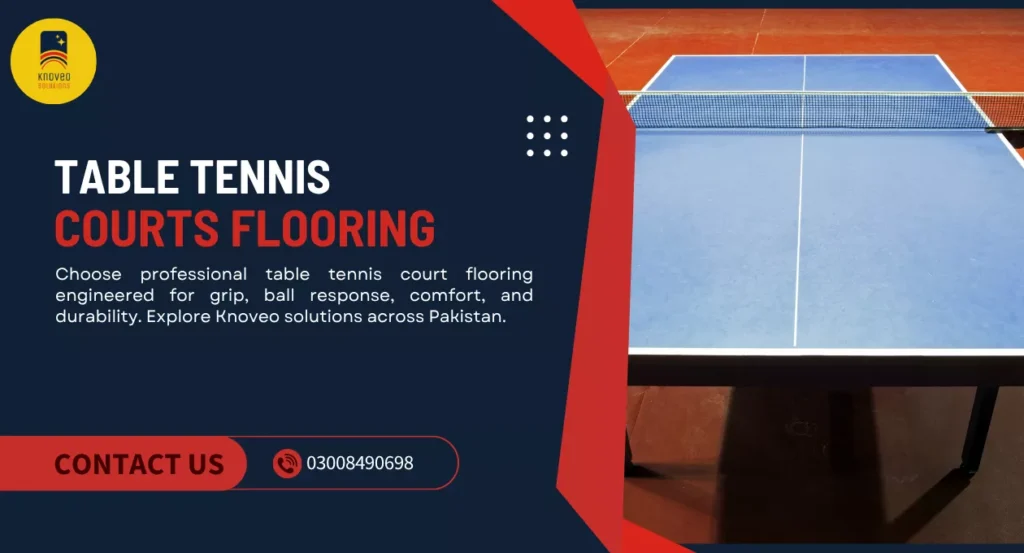
Table Tennis Courts Flooring should combine reliable traction, resilient support, low glare, and a stable subfloor. Knoveo Sports Flooring designs Pakistan-focused systems for schools, academies, clubs, corporate centres, and professional indoor venues.
What Is the Best Flooring for Table Tennis Courts?
Sports vinyl usually offers the best all-round balance for busy indoor facilities in Pakistan. Knoveo Sports Flooring may recommend seamless PU or engineered timber when venue demands, maintenance capacity, and competition goals justify the upgrade.
Table Tennis Courts Flooring performs best when the surface balances controlled grip, resilience, and predictable movement. For most Pakistani schools, academies, clubs, and corporate recreation rooms, sports vinyl flooring offers the strongest all-round value. It installs relatively quickly, feels comfortable underfoot, and supports frequent indoor use without creating a harsh concrete-like response.
Premium facilities may prefer PU sports flooring or engineered timber. PU creates a seamless multipurpose finish, while timber offers a responsive permanent system when humidity control and maintenance are dependable. Knoveo Sports Flooring evaluates traffic, subfloor condition, room use, cleaning resources, and competition goals before recommending any material.
Why Does Table Tennis Court Flooring Matter for Performance?
Flooring affects footwork, braking, comfort, and visual control throughout a match. Knoveo Sports Flooring prioritises balanced traction and resilience because players repeatedly accelerate, pivot, and recover within a compact playing area.
Fast rallies demand sharp lateral steps, quick pivots, and repeated braking. Table Tennis Courts Flooring influences how confidently your shoes engage the ground during those movements. Reliable slip resistance, measured surface friction, and useful shock absorption help create stable footwork without making the surface feel sticky, dead, or excessively soft.
The floor does not control ball bounce consistency during normal play because the ball bounces on the table. ITTF rules assign the uniform bounce requirement to the tabletop. The surrounding floor instead shapes player comfort, recovery speed, visual conditions, equipment stability, and overall player safety throughout training or competition.
Types of Table Tennis Court Flooring Compared
Vinyl, polyurethane, timber, rubber, and rigid coatings deliver very different performance profiles. Knoveo Sports Flooring compares each option by traction, resilience, seams, repairability, installation risk, maintenance, and whole-life cost.
Different sports flooring systems solve different operational problems. Vinyl provides useful cushioning and replaceable roll sections for busy facilities. Seamless polyurethane handles multipurpose use with fewer joints. Engineered timber offers premium responsiveness for permanent halls. Rubber tiles suit casual recreation better than elite play, while rigid epoxy or bare concrete often feels too unforgiving for prolonged footwork.
A smart comparison examines installation complexity, repair method, surface uniformity, lifecycle cost, and documented compliance. Product thickness alone never proves overall sporting performance. A well-engineered 4.5 mm product may outperform a poorly specified thicker layer. Knoveo Sports Flooring therefore compares the complete build-up rather than promoting one headline measurement.
| Flooring type | Main strength | Important limitation | Suitable use |
| Sports vinyl | Cushioned, practical, and relatively quick to install | Seams and substrate quality require careful control | Schools, academies, and clubs |
| Seamless PU | Uniform applied finish with strong multipurpose potential | Requires trained application and protected curing | Commercial and multipurpose halls |
| Engineered timber | Premium permanent playing feel | Moisture and maintenance need disciplined control | High-end permanent venues |
| Rubber tiles | Comfortable and easily replaceable | Joints and texture may affect serious footwork | Casual recreation rooms |
| Rigid coating | Durable and visually clean | Hardness or friction may feel unsuitable | Carefully evaluated multipurpose spaces |
How to Choose Table Tennis Court Flooring in Pakistan
Pakistan projects must account for climate, dust, slab moisture, uneven concrete, product availability, and maintenance capability. Knoveo Sports Flooring inspects the site before recommending any system or issuing an installed quotation.
Table Tennis Courts Flooring in Pakistan must suit more than the sport itself. Lahore heat, Karachi humidity, dusty entrances, intermittent climate control, and variable concrete quality can change installation risk. Knoveo Sports Flooring starts with a site survey because imported product quality cannot compensate for trapped moisture, weak screed, or uneven levels.
You should also match the floor with daily playing hours, user age, wheelchair access, movable equipment, cleaning staff, and replacement availability. Table tennis flooring Pakistan projects become easier to manage when technical data, batch details, warranties, spare material, and approved maintenance products are confirmed before purchase.
Table Tennis Court Flooring Specifications and Standards
ITTF rules require resilient flooring that is not slippery, light-coloured, or brightly reflective. World, Olympic, and Paralympic title competitions require wood or an ITTF-authorised rollable synthetic product.
Current ITTF flooring standards require the competition floor to be resilient, non-slippery, not light-coloured, and not brightly reflective. World, Olympic, and Paralympic title competitions require wood or an ITTF-authorised rollable synthetic product. Knoveo Sports Flooring distinguishes these formal requirements from ordinary recreational suitability when preparing a proposal.
International playing conditions also consider the entire room. The standard competition cuboid measures at least 14 metres long, 7 metres wide, and 5 metres high. Lighting, surrounds, background contrast, and floor finish work together, so a compliant product cannot rescue a poorly designed venue on its own.
Knoveo Sports Flooring Performance Evaluation Framework
The Knoveo performance framework evaluates traction, resilience, flatness, facility compatibility, documentation, maintenance, and lifecycle value. It replaces brochure-based decisions with a consistent technical review of both product and installation risk.
Knoveo Sports Flooring evaluates each proposal through a performance-first framework instead of relying on colour, brand familiarity, or price alone. The review covers traction, resilience, visual control, substrate readiness, usage intensity, cleaning demands, documentation, repairability, and lifecycle value. This method helps clients evaluate sports flooring with consistent evidence.
The framework also prevents misleading precision during product comparison. One laboratory value cannot describe the whole court, and a passing material can still fail after poor installation. Knoveo Sports Flooring combines documentation with site observations, installer controls, and handover checks. The result is a practical acceptance decision rather than a brochure-based assumption.
Table Tennis Court Flooring Installation Process
Successful flooring installation begins with a sound, dry, clean, and level substrate. Knoveo Sports Flooring controls preparation, acclimatisation, bonding, seaming, curing, inspection, and documented handover as one connected process.
Table Tennis Courts Flooring installation begins below the finished surface. Knoveo Sports Flooring inspects concrete strength, moisture, cracks, contaminants, level changes, and previous coatings before materials arrive. This early diagnosis protects adhesion, appearance, and service life while reducing last-minute variation costs during the installation programme.
The selected system then follows manufacturer-approved acclimatisation, layout, bonding, seaming, coating, or timber assembly procedures. Work areas need controlled access and suitable environmental conditions. Knoveo Sports Flooring records batches, adhesive coverage, curing periods, joint quality, edge details, and final cleaning before inviting the client to inspect the completed court.
Cleaning and Maintenance Requirements
Regular cleaning preserves traction and appearance while protecting the flooring warranty. Knoveo Sports Flooring recommends dust control, prompt spill removal, compatible neutral cleaners, and material-specific inspections instead of harsh household chemicals.
Proper maintenance protects traction and appearance without leaving a slippery film. Knoveo Sports Flooring recommends frequent dust removal, prompt spill response, and controlled damp cleaning with manufacturer-approved neutral products. Grit acts like sandpaper, while harsh chemicals, abrasive pads, and excess water can damage finishes or shorten service life.
Every maintenance plan should match the chosen material and traffic. Vinyl needs clean entry zones and non-staining furniture protection. PU requires regular coating inspections and compatible cleaning products. Timber demands careful moisture control and periodic refinishing. A written sports floor maintenance programme keeps responsibilities clear and supports warranty compliance across schools, clubs, and commercial centres.
Book your flooring consultation
Share your city, room dimensions, current subfloor, venue type, expected daily use, preferred completion date, and budget range with Knoveo Sports Flooring. The team can arrange an assessment, recommend a suitable system, explain installation requirements, and prepare a project-specific quotation for your table tennis facility in Pakistan.