What Is Hospital and Clean Room Flooring?
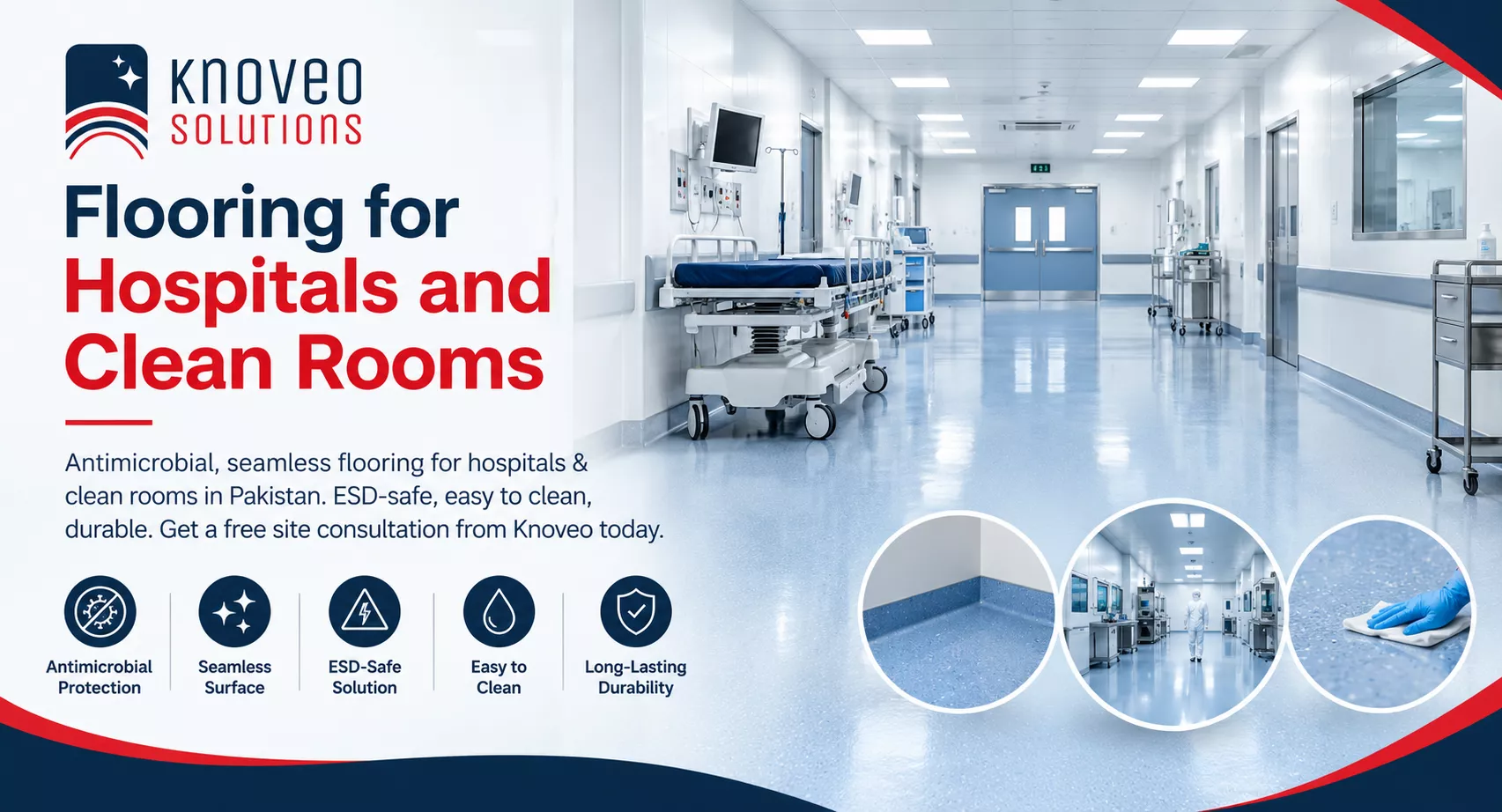
Flooring for Hospitals and Clean Rooms is a specialised, seamless surfacing system engineered to resist bacteria, chemicals, and static build-up in sterile healthcare environments. It typically includes vinyl, epoxy, or PVC materials tested against ISO 14644 clean room classification standards. Knoveo Solutions designs and installs these systems for hospitals, labs, and pharmaceutical facilities across Pakistan.
Think of your hospital floor as a silent guardian standing between patients and infection. Ordinary tiles simply can't keep pace with the demands of an operation theatre or ICU. That's exactly why hygienic flooring solutions rely on non-porous, chemically engineered materials built to survive constant scrubbing, foot traffic, and sterilisation cycles.
You'll find this flooring category divided broadly into three families: vinyl, epoxy, and PVC, each offering distinct advantages for medical use. Flooring for healthcare facilities Pakistan must additionally handle local humidity, dust, and frequent chemical disinfection routines, something Knoveo Solutions accounts for in every single product recommendation.
Why Hygiene-Grade Flooring Matters in Healthcare Facilities
Hygiene-grade flooring matters because untreated or jointed surfaces trap bacteria, moisture, and pathogens, raising infection risk inside clinical spaces. WHO infection-control guidance recommends seamless, easy-to-disinfect flooring for high-risk zones like ICUs and operation theatres. Knoveo Solutions engineers flooring that meets this exact hygiene standard for Pakistani healthcare providers.
You've probably heard the phrase "hospital-acquired infection," and yes, your floor plays a bigger role in that story than you'd think. Cracks, grout lines, and worn seams become breeding grounds for bacteria. That's precisely where infection control flooring steps in, sealing every joint against contamination.
Beyond infection prevention, hygiene-grade flooring supports staff safety and daily efficiency. Slip-resistant hospital flooring reduces accident risk in wet zones like scrub rooms and sterilisation bays. When your facility invests in the right surface, you're protecting patients, staff, and your reputation all at once, a win worth prioritising early.
Types of Flooring for Hospitals and Clean Rooms
The primary flooring types used in hospitals and clean rooms are homogeneous vinyl, epoxy resin, and conductive PVC, each installed between 2mm and 4mm thick. Selection depends on foot traffic, chemical exposure, and static-control requirements within the facility. Knoveo Solutions supplies and installs all three systems, tailored to Pakistan's climate and compliance needs.
Choosing the right material isn't a one-size-fits-all decision, and that's actually good news for you. Epoxy resin flooring delivers outstanding chemical resistance for labs handling reagents and cleaning agents. Meanwhile, PVC medical flooring brings flexibility and comfort underfoot, ideal for long shifts in busy hospital corridors.
Your facility's specific function should drive this decision, not just budget alone. Seamless vinyl flooring suits ICUs and general wards beautifully, while conductive systems protect sensitive equipment in diagnostic zones. Knoveo Solutions walks you through this selection process with real site assessments, not generic catalogue suggestions.
Homogeneous vs Heterogeneous Vinyl Flooring
Homogeneous vinyl flooring carries its colour and pattern through the entire thickness of the material, giving it exceptional durability for high-traffic clinical zones. Heterogeneous vinyl flooring uses a printed top layer over a base, making it better suited to lower-traffic administrative areas. Knoveo Solutions recommends homogeneous vinyl for ICUs and operation theatres specifically.
Homogeneous vinyl flooring wins here for wear resistance since the pattern never fades, even after years of heavy trolley and foot traffic. Heterogeneous vinyl flooring, on the other hand, offers richer design flexibility at a lower cost. You'll want homogeneous vinyl specifically wherever sterilisation cycles run daily.
Key Features of Antimicrobial and ESD-Safe Flooring
Antimicrobial flooring uses embedded silver-ion or equivalent additives to actively inhibit bacterial growth on the surface layer. ESD-safe flooring maintains controlled electrical resistance, typically between 10^6 and 10^9 ohms, preventing static discharge near sensitive equipment. Knoveo Solutions certifies its flooring systems against both requirements for hospitals and clean rooms across Pakistan.
You might not realise it, but your flooring can actively fight bacteria, not just resist it passively. Antimicrobial flooring works around the clock, even between cleaning cycles, suppressing microbial growth at a molecular level. This matters enormously in operation theatres where every second counts against contamination.
Static discharge sounds harmless until it damages a ventilator or ignites flammable anaesthetic gases. ESD (electrostatic discharge) flooring and static-control flooring dissipate charge safely before it builds to dangerous levels. Knoveo Solutions tests every batch for consistent conductivity, so your facility stays protected around sensitive diagnostic and surgical equipment.
Benefits of Seamless Flooring for Infection Control
Seamless flooring eliminates joints and grout lines through heat-welded seams and integrated coving, removing spaces where bacteria and moisture typically collect. This design makes disinfection faster and significantly more effective than tiled alternatives. Knoveo Solutions applies heat-welding on every hospital project to guarantee a fully seamless, infection-resistant finish.
Picture a floor with zero hiding spots for germs, no grout lines, no gaps, nothing. Welded seam flooring achieves exactly that by fusing every joint into one continuous surface. Non-porous flooring further blocks liquid absorption, meaning spills wipe away instantly instead of soaking in.
The wall-to-floor junction matters just as much as the floor itself. Coved skirting / integrated coving curves the flooring upward at the base, eliminating the traditional 90-degree corner where dust and bacteria love to gather. This single detail dramatically improves your facility's overall infection control performance.
Vinyl vs Epoxy vs PVC Flooring for Medical Environments
Vinyl flooring offers cost efficiency and rapid installation for general hospital wards, epoxy resin flooring delivers superior chemical resistance suited to laboratories, and PVC flooring provides the strongest static control for sensitive clean rooms. The right choice depends on your facility type, budget, and compliance obligations. Knoveo Solutions guides hospitals across Pakistan through this exact decision using on-site technical assessments.
Let's break this comparison down honestly instead of pushing one option over another. Your ICU probably needs different flooring than your pharmaceutical lab, and that's completely normal. Below is a quick comparison to help you understand where each material genuinely excels before you commit to a supplier.
| Material | Best For | Chemical Resistance | ESD Rating | Typical Lifespan |
| Vinyl | Wards, corridors | Moderate | Optional | 10–15 years |
| Epoxy | Labs, OTs | High | Low | 15–20 years |
| PVC | Clean rooms | High | Excellent | 12–18 years |
Chemical-resistant flooring like epoxy earns its keep in labs handling acids or solvents daily, while anti-static vinyl tiles protect delicate lab instruments from stray charge. Whichever material fits your operation, Knoveo Solutions sources it locally and installs it with certified precision, so you're never guessing on performance.
Where This Flooring Is Used: Operation Theatres, ICUs & Labs
Operation theatres typically require antimicrobial epoxy flooring for chemical resistance and easy sterilisation, ICUs rely on seamless vinyl for comfort and hygiene, and diagnostic laboratories need ESD-safe PVC to protect sensitive instruments. Each zone demands a distinct flooring specification based on its unique risk profile. Knoveo Solutions customises flooring separately for every one of these critical healthcare zones in Pakistan.
No two rooms in your hospital face identical risks, so why should they share identical flooring? Operation theatre flooring must withstand aggressive disinfectants and constant equipment movement without cracking. Your surgical outcomes genuinely depend on details this small, which is exactly why material selection deserves serious attention here.
ICU flooring solutions prioritise comfort underfoot for long nursing shifts alongside airtight hygiene control. Laboratory flooring, meanwhile, must resist spills from reagents and solvents used in daily testing. Pharmaceutical clean room flooring goes a step further, often needing GMP compliance for manufacturing environments Knoveo Solutions regularly equips.
Compliance Standards for Hospital Flooring in Pakistan
Hospital flooring in Pakistan should align with Pakistan Engineering Council construction guidelines, ISO 14644 clean room classification, and internationally recognised GMP compliance benchmarks. These standards ensure flooring withstands sterilisation protocols and passes healthcare facility inspections. Knoveo Solutions installs flooring systems engineered to satisfy both local and international compliance requirements simultaneously.
Compliance isn't just paperwork, it's the framework that keeps your patients genuinely safe. ISO 14644 clean room classification defines acceptable particle counts for different room grades, directly influencing which flooring material qualifies. Class 100/1000/10000 clean room standards each demand progressively stricter surface performance from your chosen flooring system.
GMP-compliant flooring becomes non-negotiable for pharmaceutical manufacturing units seeking regulatory approval within Pakistan. Low-VOC flooring further supports healthier indoor air quality, an increasingly important consideration for accreditation bodies. Knoveo Solutions ensures every installation documentation aligns cleanly with these evolving PK regulatory expectations.
Installation Process by Knoveo Flooring Experts
Knoveo Solutions follows a structured installation sequence involving substrate moisture testing, surface levelling, heat-welded seam sealing, and coved skirting application. This method ensures a fully hygienic, joint-free finish that meets clean room compliance standards. Certified technicians experienced in Pakistan's hospital construction environment handle the entire process from start to finish.
You deserve full transparency about what happens before your new floor goes down. The process always starts with substrate testing, checking moisture and levelness, because a flawed base ruins even premium materials. Skipping this step is exactly how lesser installers create problems that surface months later.
- Site assessment and substrate moisture testing
- Surface levelling and priming
- Precision-cut flooring installation with heat-welded seams
- Coved skirting application at wall junctions
- Final inspection and handover documentation
Here's exactly how Knoveo Solutions structures every hospital project from day one. Following this sequence guarantees consistency across every site, regardless of size or complexity. Your facility receives complete documentation at handover, so future maintenance teams know precisely what's beneath their feet.
Why Choose Knoveo for Hospital & Clean Room Flooring in Pakistan
Knoveo Solutions is a trusted provider of hospital and clean room flooring in Pakistan, offering certified installation teams, compliance-driven material sourcing, and proven expertise across ICUs, operation theatres, and diagnostic laboratories. Their complete service model covers consultation, supply, and installation under one accountable process. This makes Knoveo Solutions a preferred flooring partner for healthcare facilities nationwide.
You want a flooring partner who understands healthcare, not just construction in general. Knoveo Solutions brings genuine experience across hospitals, labs, and even commercial flooring Pakistan projects, giving you confidence that your specific requirements are fully understood before a single tile arrives on site.
Beyond hospitals, Knoveo Solutions extends its expertise through Sports and healthcare flooring solutions Knoveo projects nationwide, proving versatility across demanding environments. Anti-bacterial floor coating options, certified installation teams, and transparent compliance documentation come standard with every contract. Choosing Knoveo means choosing accountability from quotation through to final handover.
Ready to Upgrade Your Facility's Flooring?
Getting started is simpler than you think. Reach out to Knoveo Solutions today for a free, no-obligation site assessment, and our technical team will recommend the exact flooring system your hospital, lab, or clean room genuinely needs, backed by compliance documentation and transparent pricing from day one.
Book your free consultation with Knoveo Solutions and get a customised hospital flooring plan within 48 hours.
Frequently Asked Questions
- What is hospital and clean room flooring?
It is specialised seamless flooring designed to resist bacteria, chemicals, moisture, and static build-up in healthcare and sterile environments. - Which flooring is best for hospitals?
Homogeneous vinyl, epoxy resin, and conductive PVC are commonly used, with the choice depending on traffic, chemical exposure, and ESD requirements. - Why is seamless flooring important in healthcare?
Seamless flooring eliminates joints and grout lines where bacteria and moisture can collect, making cleaning and disinfection easier. - Where is ESD-safe flooring used?
ESD-safe flooring is particularly useful in clean rooms, diagnostic areas, and laboratories where sensitive equipment needs protection from static discharge. - How is hospital flooring installed by Knoveo?
The process includes site assessment, moisture testing, surface levelling, flooring installation with heat-welded seams, coved skirting, and final inspection.